How to Research School Catchment Areas in Australia
Choosing a school is one of the biggest decisions Australian families make — and it often determines where they live. But researching schools properly means looking beyond just the school itself. The suburb demographics, transport options, housing costs, and safety profile of the surrounding area all matter.
This guide covers what public data is available for Australian schools, how to combine it with suburb-level information, and where to find it all without spending hours on government websites.
What data is publicly available for Australian schools?
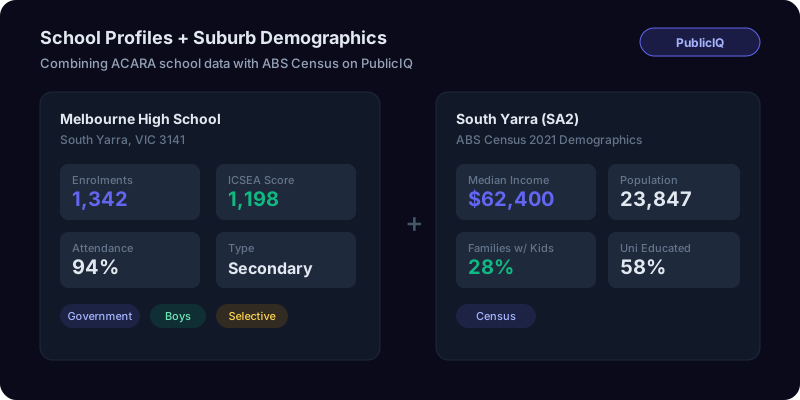
ACARA (Australian Curriculum, Assessment and Reporting Authority) publishes a profile for every school in Australia through the My School website. Key data points include:
- Enrolments — Total student numbers, broken down by year level
- ICSEA score — Index of Community Socio-Educational Advantage, a measure of the school community's socio-educational background (national average is 1,000)
- Attendance rates — By year level, showing the percentage of school days attended
- School type — Government, Catholic, or Independent; primary, secondary, or combined
- Teaching staff — Number of full-time equivalent teaching staff
This data is updated annually and covers every registered school in the country.
Why school data alone isn't enough
ACARA data tells you about the school. But families also need to understand the area around the school — and that requires a different set of data entirely.
Questions that school data doesn't answer:
- What's the median household income in this suburb? This affects everything from the school community's fundraising capacity to the cost of living nearby.
- How many families with children live here? A suburb with a high proportion of families typically has better support infrastructure — playgrounds, sports clubs, childcare.
- What are the crime rates? Safety around the school and on the route home matters. Crime statistics at the LGA level can flag areas of concern.
- What does housing cost? Whether you're buying or renting, knowing median property prices and rents in the school's catchment is essential for planning.
- What's the education profile? The percentage of residents with tertiary qualifications can indicate the community's general orientation toward education.
Where to find suburb-level data
The data exists, but it's fragmented across multiple agencies:
| Data | Source | Format |
|---|---|---|
| Demographics & income | ABS Census 2021 | TableBuilder / DataPacks |
| Crime statistics | State police agencies (VIC, NSW, QLD, WA, SA) | CSV downloads, varying formats |
| School profiles | ACARA / My School | Online, limited export |
| Rental & property | State housing authorities, ABS | Various portals |
| Transport access | State transport agencies | GTFS feeds |
Pulling this together manually for even a single suburb is time-consuming. Doing it for multiple suburbs — which is what most families need when comparing options — can take days.
A better approach
Rather than visiting five different government websites and trying to reconcile different geographic boundaries, you can use SuburbIQ to search any Australian suburb and see school profiles, Census demographics, crime statistics, and housing data in one place.
The platform combines ACARA school data with ABS Census demographics at the SA2 level, so you can see a school's profile alongside the suburb's income, education, family structure, and safety data — all on the same screen.
This is especially useful when comparing two or three suburbs. Instead of opening dozens of browser tabs, you can do a side-by-side comparison with all the relevant data aligned.
What to look for when researching
Here's a practical checklist for evaluating a school and its surrounding area:
School-level indicators:
- ICSEA score relative to the national average (1,000)
- Attendance rates above 90%
- Student-to-teacher ratio
- School type and year levels offered
Suburb-level indicators:
- Median household income vs. housing costs (affordability)
- Proportion of families with children under 15
- Percentage of residents with tertiary education
- Crime rates at the LGA level, particularly property crime and assault
- Public transport access (distance to train stations, bus routes)
Combining both gives you a much more complete picture than either data source alone. A school with a strong ICSEA score in a suburb with good affordability, low crime, and high family density is a very different proposition from the same school in a suburb with opposite characteristics.
Key takeaways
- ACARA publishes profiles for every Australian school — enrolments, ICSEA, attendance, and more
- Suburb demographics matter as much as the school itself — income, safety, housing costs, and family density shape the experience
- The data exists but it's fragmented — Census, crime, schools, and housing data all live in different places
- Use SuburbIQ to bring it together — search any suburb and see schools, demographics, crime, and housing data side by side